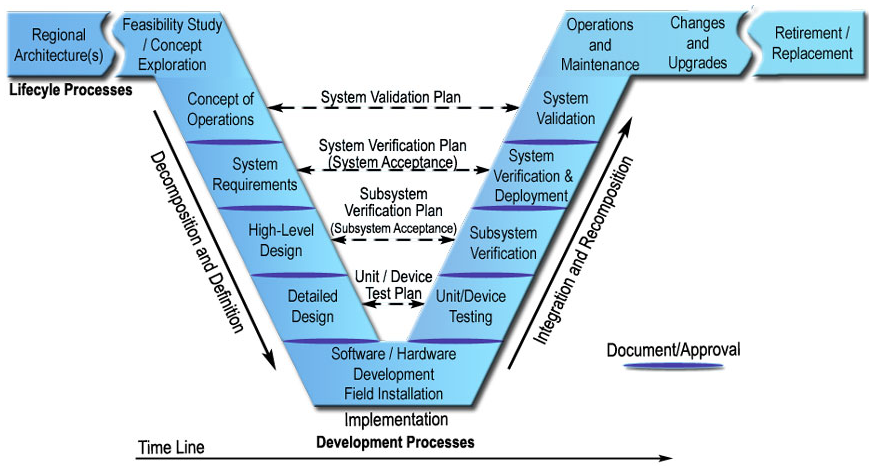
The system architecture is then defined, followed by a detailed design of the product’s sub-modules. Implementation is then carried out for these sub-modules. Once implementation is complete, the testing phases follow, beginning with a detailed verification of the sub-modules, followed by validation, integration and acceptance testing.
Why choose the V-model?
The V-model is suitable for projects where the starting points can be clearly defined, and where we can provide the client with a clear understanding of the development costs in advance.
Where there are uncertainties regarding feasibility or technical design choices that could significantly influence the design process, it may be decided to begin with a Proof of Concept phase. The aim of this is to identify the uncertainties and minimise risks. Therefore, once there is a clear picture of the budget, resources and timeframe, the V-model is usually chosen.
The advantages and disadvantages of the V-model
There are a number of advantages and disadvantages to the V-model that can be crucial when deciding whether to use this methodology. We have listed the main advantages and disadvantages for you below.
The advantages:
-
Integration is tested at every stage of the V-model.
-
The V-model can be completed relatively quickly. As the phases and their respective outcomes are clearly defined in advance, the process can be carried out without any loss of time. As a result, the lead time can be considerably shorter compared to other methods.
The disadvantages: